
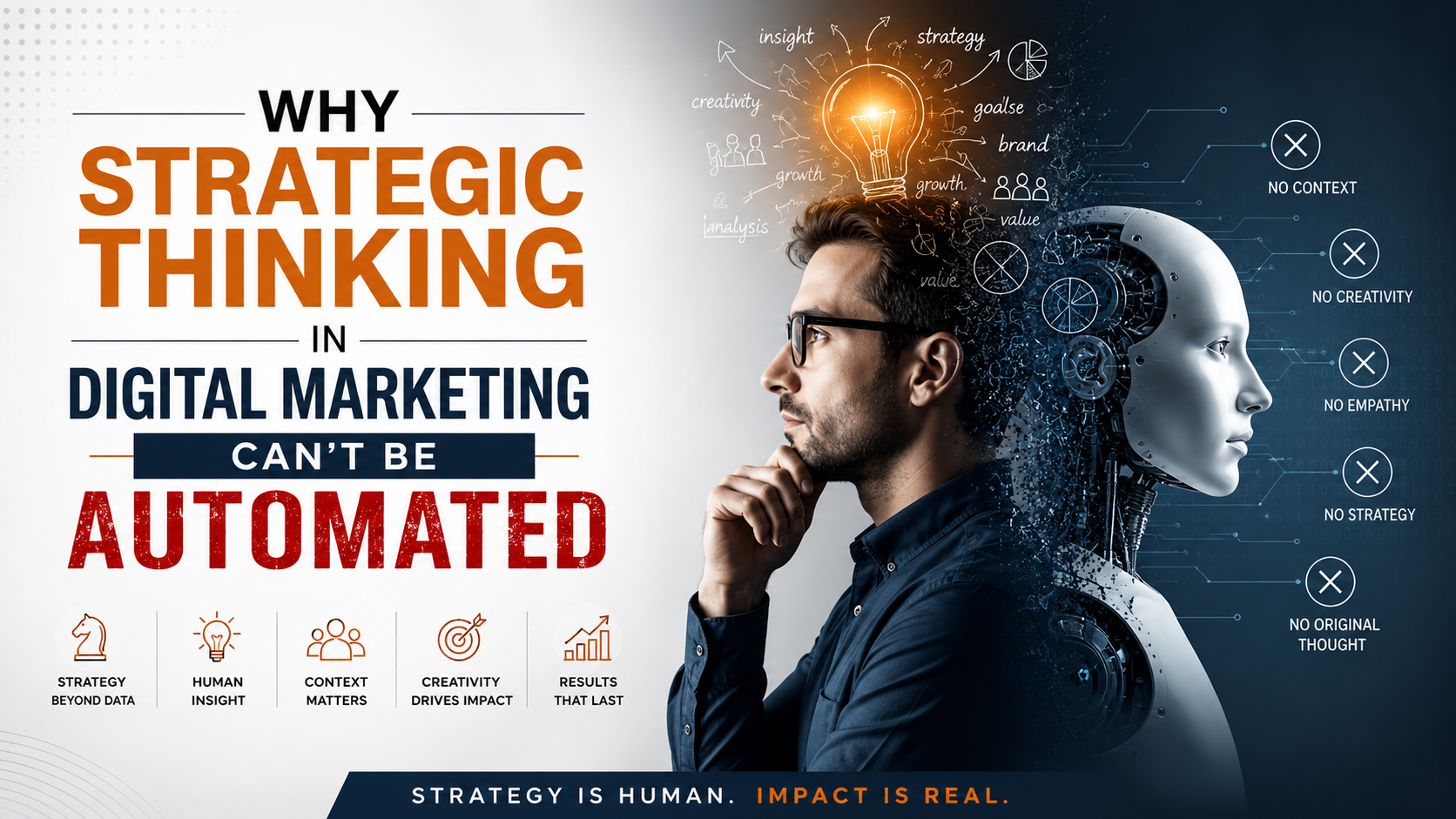
At Sankalp Digital Solutions, we’ve been helping businesses navigate the digital marketing landscape since before “AI” became the industry’s favorite buzzword. And in the last two years, we’ve watched something fascinating happen across our 100+ client portfolio.
Businesses come to us excited about automation tools. They want AI to write their content, manage their ads, segment their audiences, and optimise their campaigns. The tools promise efficiency, scale, and results—all without the overhead of a full marketing team.
Here’s what we tell them: The tools work. The problem is knowing what to tell the tools to do.
Working with companies across diverse industries—from hospitality to healthcare, e-commerce to real estate—we’ve seen a clear pattern emerge. 49% of B2B organizations say their biggest marketing automation challenge isn’t technology or budget—it’s the lack of an effective strategy. [Kafkai]
They automate email sequences nobody wants. They optimize campaigns toward metrics that don’t matter. They scale content that dilutes their brand. And they do it all faster than ever before.
Automation doesn’t fix unclear thinking—it amplifies it. When you automate a broken process, you don’t fix it. You just break things faster.
Kafkai’s article shares what we’ve learned about why strategic thinking—the human ability to decide what deserves automation and how it serves business goals, remains irreplaceable.
The Problem We Keep Seeing: Strategic Dilution
What Happens When Everyone Uses the Same AI
Last quarter, our team at Sankalp Digital Solutions analyzed 50 restaurant and hospitality brand websites across Ahmedabad and Gujarat. The results? Gradual convergence of brand positioning and messaging toward category-average language, resulting in measurable loss of competitive distinctiveness.
Everyone sounded the same. “Farm-to-table freshness,” “Authentic culinary experience,” “Unforgettable dining,” “Warm hospitality.”
This is “Strategic Dilution.” It happens because AI learns from patterns across millions of examples. Patterns represent the average—not the exceptional. Without a human strategist defining what makes your brand different, AI will make you sound like everyone else.
The Real Challenges Our Clients Face
As a full-service digital marketing agency offering services from SEO to PPC, social media marketing to conversion rate optimization, we see these challenges firsthand:
The data mirrors what we experience:
- 96% of organizations say modifying automation is challenging because systems and business requirements change [McKinsey & Co]
- 73% of marketers find marketing automation challenging—41% moderately, 31% very challenging [McKinsey & Co]
- In 2026, automation is expected to help decide what should happen next, not just execute pre-defined instructions [Kafkai]
The critical need: Someone must define the judgment framework within which automation operates. And that someone cannot be an algorithm.
Four Reasons Strategic Thinking Can’t Be Automated
1. You Have to Define What Success Actually Means
We once worked with a hospitality client who automated their lead scoring to prioritize corporate bookings with highest conversion rates. The system worked perfectly. Conversion rates went up 34%.
But six months later, they had a problem: their customer concentration risk skyrocketed. Three large corporate clients represented 65% of revenue. Their strategic goal was building a diverse customer base across leisure and business travelers—but nobody told the automation that.
AI performs best when objectives are clearly defined. When strategy is vague, automation amplifies confusion rather than resolving it. [Actuado]
Before you automate, you must answer:
- What does success look like for our business?
- Are we optimizing for revenue, retention, market share, or something else?
- What trade-offs are we willing to make?
- What happens if we succeed at the wrong thing?
These require business judgment informed by competitive positioning, resource constraints, and long-term vision—the foundation of our digital strategy services.
2. Context Always Defeats Pattern Recognition
Real example from our PPC campaigns: We managed paid advertising for a fitness client. The AI recommended tripling ad spend on a segment with 3x higher conversion rates.
Sounds good, right?
Except that segment had a 90-day churn rate of 85%. They signed up for first-month discounts and immediately canceled. The AI saw “conversions.” We saw a money pit.
Dumb data is information without context or meaning—isolated from business strategy. As HubSpot research confirms, “You’ll never have absolute data,” and therefore, arguments based on “pragmatic judgments” are needed.
Strategic thinkers do what AI can’t:
- Understand market forces beyond campaign data
- Recognize when anomalies signal opportunity rather than error
- Interpret competitive moves and adjust positioning
- Balance quantitative signals with qualitative insights
A critical balance must be maintained to ensure AI functions as a tool rather than a substitute for judgment.
3. Short-Term Wins Can Destroy Long-Term Value
We’ve seen this dozens of times across our client portfolio: A retail client runs a discount campaign. It performs brilliantly—conversions spike, the AI learns that discounting works, so it recommends more discounts.
Six months later, they can’t sell at full price. Their brand is now “the cheap option.” Customer lifetime value collapses. But the AI never saw this coming.
Large Language Models (LLM) exhibit structural limitations in meta-strategic judgment, differentiation, and context-dependent trade-offs.
Examples of dangerous trade-offs we’ve prevented:
- Aggressive retargeting that increased conversions but damaged brand perception
- Content strategies that improved SEO rankings but diluted thought leadership positioning
- Personalization tactics that boosted engagement but felt invasive to customers
These require creativity, vision, and long-term strategic thinking—exactly what our team brings to every campaign.
4. Someone Has to Ask “Should We?”
85% of business leaders experience overwhelming data volume and decision-making stress daily, and they’re increasingly turning to AI for support.
But AI support is different from delegating judgment to AI.
A case that changed our approach: A healthcare client wanted to automate highly personalized emails using behavioral tracking. The AI could do it—tracking every click, hesitation, and responding with perfectly timed messages.
Technically impressive. Strategically questionable.
We asked: “If patients knew how much you’re tracking them, would they feel cared for or creeped out?” That question stopped the project. Not because the technology didn’t work—but because the ethics were unclear.
As one case demonstrates, employees in the Netherlands were terminated based on AI-driven recommendations, emphasizing dangers of overreliance without human oversight.
Strategic thinkers ask questions AI never will:
- Are we building trust or just driving conversions?
- Should we do this, even if we could?
- Does this respect our customers’ dignity?
What We See When Automation Runs Without Strategy
Problem 1: Broken Processes at Scale
The most common issues are teams automating broken processes, treating automation as scheduling rather than strategy, ignoring data quality, and measuring activity instead of impact.
Problem 2: Optimising the Wrong Things
Many teams deploy AI before aligning on what success means. AI then optimizes toward proxy metrics that are easy to measure but weakly connected to outcomes.
We see this constantly across our services:
- Maximizing email open rates → while destroying deliverability
- Driving website traffic → that never converts to inquiries
- Increasing social media engagement → with audiences outside their target market
The automation works. The metrics improve. The business suffers.
Problem 3: Dashboard Overload Without Insight
The average adult makes 35,000 decisions a day. At that rate, the brain is running on fumes by mid-afternoon.
Marketing leaders spend hours staring at dashboards full of conflicting data. The problem isn’t lacking information—it’s that dashboards full of ‘dumb’ data demand attention without offering clarity.
Our approach at Sankalp Digital Solutions: We design systems that surface insight, not just information. We help clients identify the 3-5 metrics that actually matter for their specific business goals.
What Actually Works: Human Strategy + AI Execution
The Data Behind Our Approach
Forrester research indicates marketing automation can improve productivity by up to 20%—but only with clear strategic direction.
Organizations with mature technology adoption processes are 2.5x more likely to implement new technologies successfully.
This matches our experience exactly. Success isn’t about the most sophisticated tools—it’s about the clearest strategy.
How We Structure the Collaboration
In 2026, platforms enable complex strategic outcomes through orchestration—continuously deciding how and where to engage based on live signals. [HubSpot]
But orchestration requires a conductor.
How we divide responsibilities at Sankalp Digital Solutions:
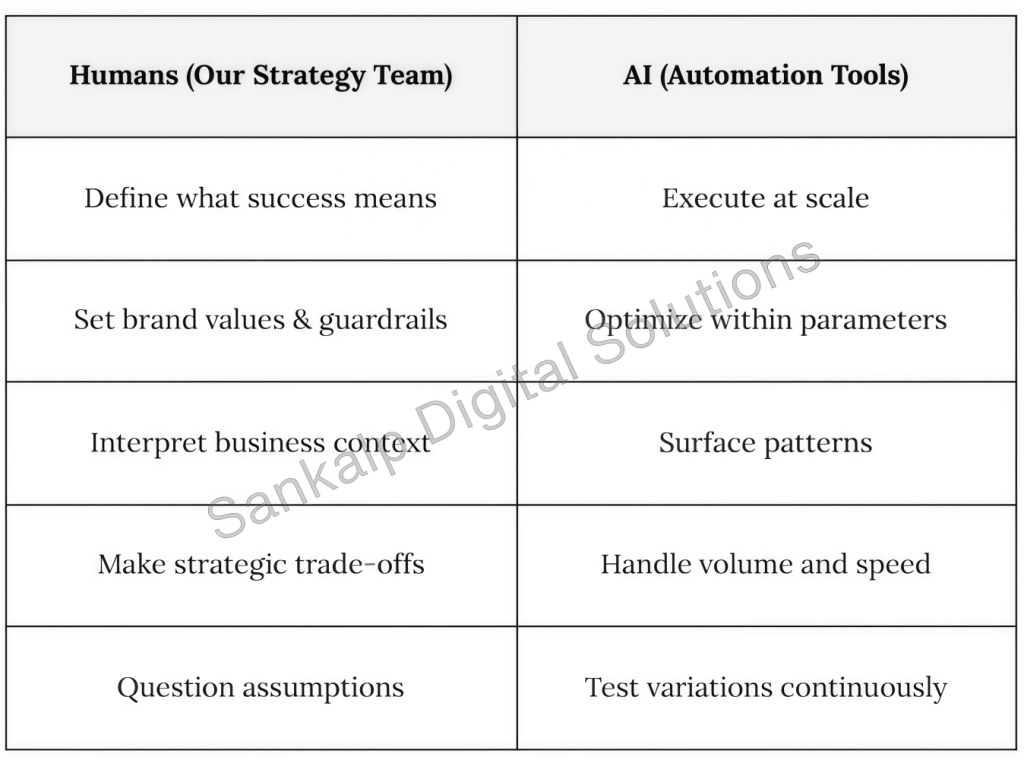
When AI outputs conflict with experience or context, high-performing teams investigate instead of complying automatically. Judgment prevents AI from accelerating mistakes.
Our Process: Start Small, Learn Fast, Scale Smart
Automation should start small, learn quickly and expand deliberately. And it should be reviewed regularly.
Phase 1: Strategy Before Technology
- Define clear business outcomes (not just marketing metrics)
- Identify the 3-5 KPIs that actually matter
- Map customer journey and decision points
- Establish brand guidelines and ethical boundaries
Phase 2: Pilot with Feedback Loops
- Automate one small, measurable process
- Set up weekly reviews to question assumptions
- Look for unintended consequences
- Adjust based on learnings
Phase 3: Scale What Works
- Expand automation only after proving it serves the strategy
- Build in regular review cycles
- Keep human oversight on key decisions
Questions we ask monthly:
- When did we last review this against our strategy?
- Is this automation still serving current goals?
- What unintended behaviours is it creating?
- Are we optimising the right things?
Strategic Thinking in Practice
Knowing When NOT to Automate
A hospitality client wanted to automate guest experience outreach for their premium hotel properties. AI could detect stay patterns, identify satisfaction scores, and trigger follow-up sequences automatically.
We recommended against it.
Why? Their guests expected personalized attention from dedicated relationship managers—it’s what they paid premium rates for. Automating would save time but destroy the luxury experience.
There is still a place for human judgment, and it is essential to ensure AI is regarded as an ethical problem-solver requiring commitment from all organizational levels.
Extracting Meaning from Data
For an e-commerce client, we noticed conversion rates dropped 15%. AI flagged it as an ad targeting problem. But when our team dug deeper, we found a major competitor had launched a new product that repositioned the entire category.
The data showed correlation. Human analysis identified causation. We pivoted the entire campaign strategy—something automation would never catch.
Balancing Multiple Time Horizons
Our framework across all client engagements:
- Immediate (0-3 months): What can we test and optimize now?
- Strategic (3-12 months): What are we building toward?
- Brand (1-3 years): What do we want to be known for?
Every automation decision gets filtered through all three time horizons—a principle we apply whether we’re managing your SEO, PPC campaigns, or social media marketing.
The Future: Why Judgment Becomes More Valuable
As AI becomes standard, the differentiator will no longer be access to tools. It will be the quality of judgment applied around them.
Every competitor has access to the same automation platforms, AI writing tools, predictive analytics, and data sources.
The only sustainable advantage is the quality of thinking that directs all of it.
Marketing leaders will be evaluated not on how efficiently campaigns are optimized, but on how clearly marketing activity connects to revenue outcomes.
This is why at Sankalp Digital Solutions, we’ve built our entire service model around strategic thinking first, technology second. Our team of digital marketing experts brings decades of combined experience across industries, ensuring that every automation decision serves your actual business goals.
Key Takeaways
✓ Strategic Dilution kills differentiation: When everyone uses AI the same way, all brands sound identical
✓ The gap is strategy, not technology: 49% of B2B organizations cite lack of strategy as their biggest challenge
✓ Four capabilities AI will never have: Defining success, interpreting context, managing long-term trade-offs, providing ethical oversight
✓ Investigation beats compliance: Teams that question AI outputs consistently outperform those that don’t
✓ Start small, scale smart: Prove automation serves strategy before expanding
✓ The future advantage is judgment: As AI becomes commoditized, strategic thinking becomes the only differentiator
Conclusion
After years of working with diverse clients—from local businesses to global brands—here’s what we know at Sankalp Digital Solutions:
Automation is extraordinarily powerful. We use it across every service we offer, from performance marketing to content creation. But it’s also extraordinarily literal—it does exactly what you tell it to do.
The starting point is not technology. It is the intent. You need clarity on what outcomes actually matter.
AI can optimize marketing but cannot decide what to optimise for. AI can execute a strategy but cannot create a strategy. AI can process data but cannot extract meaning.
That work requires human judgment—the kind our team brings to every client engagement across our SEO, PPC, social media, content marketing, and conversion rate optimisation services.
In a world where everyone has access to the same tools, the quality of strategic thinking is the only sustainable competitive advantage left.
The brands winning in 2026 aren’t automating fastest. They’re thinking most clearly about what to automate, why to automate it, and when to keep human judgment in the loop.
Because strategic thinking can’t be automated. And that’s exactly what makes it valuable