Search is changing.
People are no longer relying only on traditional Google results to discover brands, products, services and answers. They are increasingly asking complete questions through AI-powered search experiences and conversational platforms.
Instead of searching:
“digital marketing agency Ahmedabad”
a potential customer may now ask:
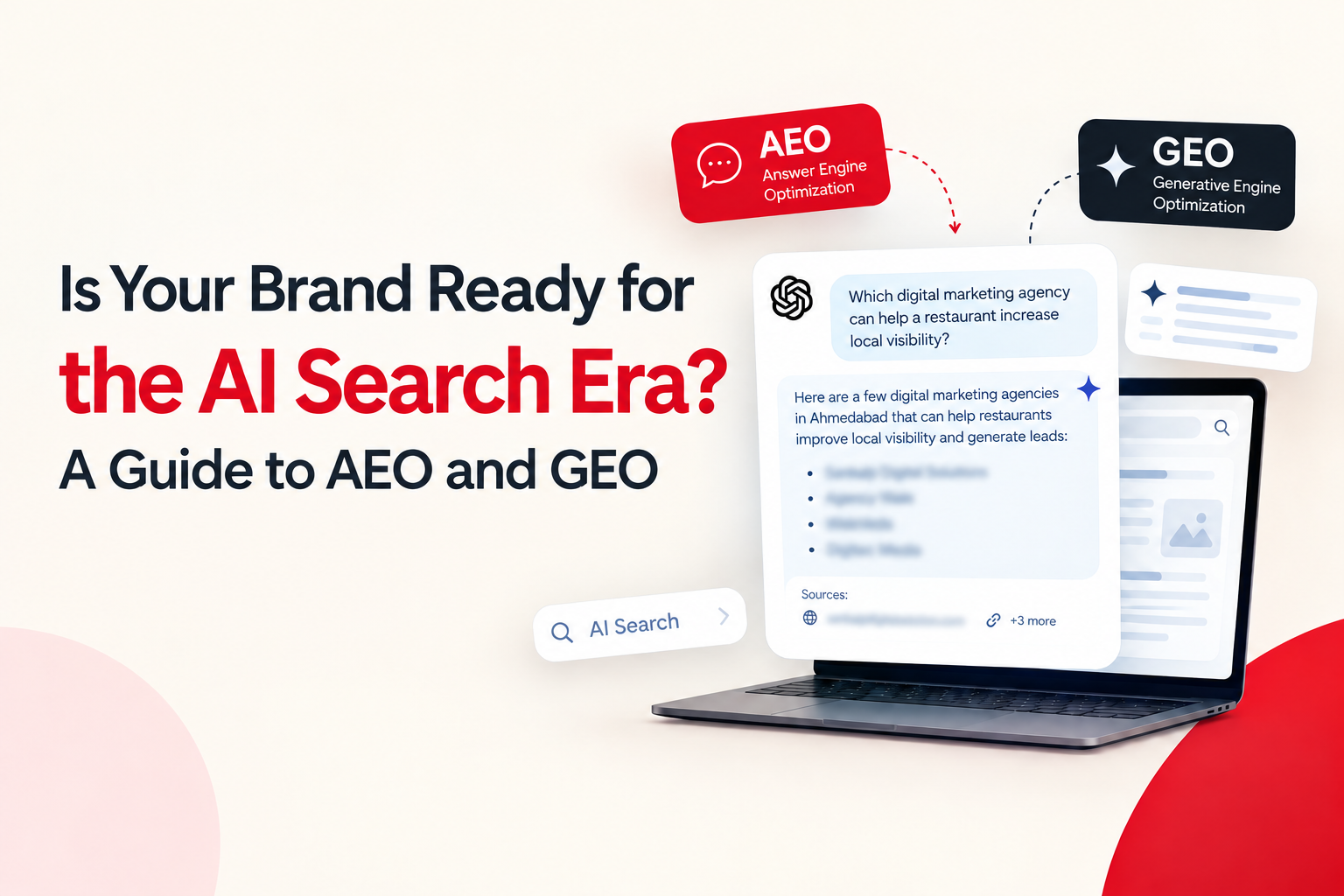
“Which digital marketing agencies in Ahmedabad can help a restaurant increase local visibility and generate leads?”
The difference is significant.
Traditional SEO focuses heavily on helping your website rank for relevant searches. The AI search era adds another challenge: helping search engines and AI systems understand your brand well enough to potentially use your content when generating an answer.
This is where AEO (Answer Engine Optimization) and GEO (Generative Engine Optimization) come into the conversation.
But AEO and GEO should not be treated as shortcuts or replacements for SEO. Google’s current guidance emphasizes that established SEO fundamentals remain important for visibility in generative AI search experiences, including AI Overviews and AI Mode.
So, is your brand ready?
Let’s understand what AI search means for businesses and what you can do to prepare.
Table of Contents
ToggleWhat Is AEO?
AEO stands for Answer Engine Optimization.
AEO focuses on making your content useful and understandable for systems that provide direct answers to user questions.
Traditional search might show a list of websites.
Answer-oriented search can provide an answer first, followed by relevant sources.
For example, a user might search:
“What should I consider before choosing a digital marketing agency?”
An AEO-friendly page could directly answer the question with clear sections covering:
- Industry experience
- Services offered
- Case studies
- Pricing and scope
- Reporting
- Local expertise
- Reviews and reputation
- Expected business outcomes
The objective is simple:
Answer the questions your potential customers are actually asking.
What Is GEO?
GEO stands for Generative Engine Optimization.
GEO focuses on improving how your brand and content can be discovered, understood and potentially referenced within generative AI experiences.
Generative AI search can combine information from multiple sources to create a response.
Google explains that its generative AI features can use techniques such as retrieval-augmented generation and query fan-out to retrieve relevant information from its search index and build responses.
This means your brand needs more than a collection of keywords.
AI systems need to understand:
- Who your business is
- What you offer
- Where you operate
- Who your services are for
- What makes your offering different
- What questions you can answer
- Whether your information is reliable and consistent
AEO vs GEO vs SEO: What’s the Difference?
These three approaches overlap, but they are not exactly the same.
| Approach | Primary Focus | Example |
| SEO | Visibility in search engines | Ranking for “digital marketing agency Ahmedabad” |
| AEO | Providing direct answers to questions | Answering “What does a digital marketing agency do?” |
| GEO | Visibility in generative AI experiences | Being considered as a relevant source when AI answers a marketing-related question |
The important point is that these strategies should work together.
- SEO builds the foundation.
- AEO makes your content answer-focused.
- GEO prepares your brand for generative search experiences.
Google’s current documentation specifically states that AEO and GEO are terms used to describe work around AI search, while its own approach continues to rely on core Search systems and SEO fundamentals.
Why AI Search Changes the Way Brands Need to Think About Content
For years, businesses have created content around keywords.
A business might create a page targeting:
“SEO agency Ahmedabad”
and another targeting:
“SEO services Ahmedabad.”
But modern search systems are increasingly capable of understanding meaning, context and related concepts.
Google’s current guidance says there is no need to rewrite content simply to target every possible wording variation. Its systems can understand synonyms and general meanings.
That means brands should move from:
“How many keywords can we add?”
to:
“How completely can we answer our customer’s problem?”
This is a major shift in content strategy.
7 Ways to Prepare Your Brand for AI Search
1. Create Content Around Real Customer Questions
Start with your audience, not just keyword volume.
Think about the questions customers ask before contacting your business.
For a digital marketing company, these could include:
- What does a digital marketing agency do?
- How much does digital marketing cost?
- How can SEO help my business?
- What is local SEO?
- How does Google AI search affect SEO?
- What is AEO?
- What is GEO?
- How can a business appear in AI search?
- How can restaurants increase local visibility?
- What is the difference between SEO and AEO?
Build useful content that answers these questions clearly.
The goal isn’t to create hundreds of thin pages. Google’s guidance specifically recommends valuable, original, people-first content instead of producing large quantities of pages primarily to manipulate search or AI results.
2. Give Clear, Direct Answers
AI-friendly content doesn’t need to sound robotic.
In fact, it should be written for humans first.
Start important sections with a concise answer, then expand with supporting information.
For example:
What is AEO?
AEO, or Answer Engine Optimization, is the practice of structuring and improving content so that it clearly answers the questions people ask through search and answer-oriented platforms.
Then explain the topic in more detail.
This structure helps users quickly understand the answer while giving search systems useful context.
3. Build Topic Authority Instead of Publishing Random Blogs
One isolated blog about SEO may not establish a strong topical relationship.
Instead, build content clusters.
For example:
Core Topic: AI Search
Supporting topics could include:
- What is AI Search?
- AEO vs SEO
- AEO vs GEO
- How GEO works
- How AI Overviews affect businesses
- How to optimize content for AI search
- Structured data and AI search
- Local SEO in the AI era
- How businesses can measure AI search visibility
Together, these pages create a stronger knowledge ecosystem around your expertise.
4. Make Your Business Information Consistent
AI systems need reliable information about your business.
Make sure important details are consistent across your website and relevant online profiles.
These can include:
- Business name
- Services
- Locations
- Contact information
- Business description
- Industry expertise
- Team information
- Reviews
- Social profiles
- Business listings
For local businesses, accurate location and business information becomes particularly important.
Google also recommends keeping relevant business information, such as Business Profile information, up to date as part of its broader search best practices.
5. Use Structured Data Correctly
Structured data helps search engines understand what a page represents.
Depending on your website, relevant structured data may include:
- Organization
- LocalBusiness
- Service
- Article
- Breadcrumb
- Product
- Person
- Event
- Review-related structured data where eligible
However, structured data should not be treated as an “AI ranking hack.”
Google states that structured data is not required for inclusion in AI Overviews or AI Mode, and there is no special AI-only schema that guarantees visibility. It remains useful as part of an overall SEO strategy and can help Google understand page content.
The rule is simple:
Use structured data to accurately describe the content that users can actually see on the page.
6. Strengthen Your Website’s Technical SEO
Before worrying about AEO or GEO, make sure search engines can access your website.
Check:
- Indexability
- Robots.txt
- XML sitemap
- Internal linking
- Mobile usability
- Page experience
- HTTPS
- Core technical issues
- Canonical URLs
- Metadata
- Crawlability
- JavaScript rendering where applicable
Google’s guidance says pages need to be indexed and eligible to appear in normal Google Search in order to be eligible as supporting links in AI Overviews or AI Mode.
In other words:
If search engines cannot properly discover and understand your website, AI search visibility becomes much harder.
7. Create Original, Experience-Based Content
This may become one of the biggest differentiators in AI-era content marketing.
Generic content can be generated almost anywhere.
Your business has something AI-generated generic content doesn’t automatically have:
real experience.
Use:
- Original case studies
- Client experiences
- Campaign insights
- Industry-specific examples
- Expert opinions
- First-hand observations
- Original research
- Before-and-after examples
- Real FAQs
- Practical processes
Google’s current generative AI guidance emphasizes unique, valuable and non-commodity content rather than simply reproducing information that already exists online.
Don’t Chase Every “AI SEO Hack”
The growth of AI search has also created a growing number of supposed optimization tricks.
Some advice suggests that businesses must create special AI files, break every article into tiny content chunks, or generate artificial online mentions.
Google’s current guidance specifically pushes back on several of these assumptions.
For example, Google says that llms.txt and similar AI-specific files are not required for visibility in Google Search or its generative AI features, and Google Search does not use them as a special ranking requirement.
Similarly, there is no required “perfect” content length or mandatory chunking format for AI search.
The better approach is:
Create useful content first. Optimize the technical foundation. Make your information clear, accurate and accessible.
How Can You Measure AI Search Visibility?
AI search introduces a new measurement challenge.
Traditional SEO reporting may focus on:
- Rankings
- Organic traffic
- Impressions
- Clicks
- Conversions
- Keyword visibility
But businesses increasingly need to consider visibility within generative search experiences too.
Google introduced dedicated generative AI performance reporting in Search Console, providing visibility into impressions from generative AI features such as AI Overviews and AI Mode. Google announced that these insights had rolled out worldwide by August 31, 2026.
This gives marketers another source of data when evaluating how their websites are appearing across evolving search experiences.
The Future of Search Is Not SEO vs AI
The conversation shouldn’t be:
SEO OR AEO OR GEO?
It should be:
SEO + AEO + GEO
SEO remains the foundation.
AEO encourages businesses to answer customer questions clearly.
GEO brings greater attention to how brands and content may be discovered and referenced in generative AI experiences.
The underlying principle remains the same:
Help people find accurate, useful and trustworthy information.
As AI-powered search continues to evolve, businesses that build strong digital foundations and consistently publish valuable content will be better positioned to adapt.
Is Your Brand Ready for the AI Search Era?
AI search is changing how people discover information, but the fundamentals haven’t disappeared.
Your website still needs to be crawlable.
Your content still needs to be useful.
Your business information still needs to be clear.
Your pages still need strong technical foundations.
And your brand still needs to provide something valuable to the people you want to reach.
At Sankalp Digital Solutions, we help businesses build stronger digital visibility through SEO, content, performance marketing and emerging AEO/GEO strategies.
If your brand is preparing for the next generation of search, now is the time to evaluate whether your website is ready—not just to rank, but to be understood.
Ready to make your brand AI-search ready? Explore digital marketing and AEO/GEO solutions with Sankalp Digital Solutions.